Tuesday, June 3, 2014

Monday, October 7, 2013
Quinoa (Chenopodium quinoa) बथुआ
Quinoa


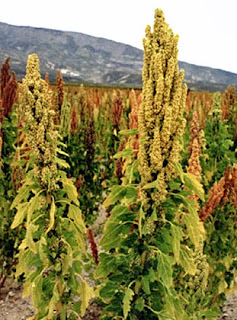

It is a pseudo cereal rather
than a true cereal, or grain, as it is not a member of the true grass family.
As a chenopod, quinoa is closely related to species such as beetroots, spinach
and tumbleweeds.
The popularity of quinoa in
non-indigenous regions has raised concerns over food security. Due to continued
widespread poverty in regions where quinoa is produced, and because few other
crops are compatible with the soil and climate in these regions, it is
suggested that the inflated price of quinoa disrupts local access to food
supplies.


International Year of Quinoa
The United
Nations General Assembly declared 2013 as the "International Year of
Quinoa" in recognition of ancestral practices of the Andean people, who
have preserved quinoa as food for present and future generations, through
knowledge and practices of living in harmony with nature. The objective is to
draw the world’s attention to the role that quinoa plays in providing food
security, nutrition and poverty eradication, in support of achieving Millennium
Development Goals.
Quinoa was
important to the diet of pre-Columbian Andean civilizations. Today, people
appreciate quinoa for its nutritional value. Quinoa has been called a
superfood. Protein content is very high for a cereal/pseudo-cereal (14% by
mass), yet not as high as most beans and legumes. Quinoa's protein content per
100 calories is higher than brown rice, potatoes, barley and millet, but is
less than wild rice and oats. Nutritional evaluations of quinoa indicate that
it is a source of complete protein. Furthermore, it is a good source of dietary
fiber and phosphorus and is high in magnesium and iron. Quinoa is also a source
of calcium, and thus is useful for vegans and those who are lactose intolerant.
Quinoa is gluten-free and considered easy to digest. Because of all these
characteristics, quinoa is being considered a possible crop in NASA's
Controlled Ecological Life Support System for long-duration human occupied
spaceflights.
Nutritional value
|
|
Quinoa, uncooked
|
|
Nutritional value per 100 g (3.5 oz)
|
|
Energy
|
1,539 kJ (368 kcal)
|
Carbohydrates
|
64 g
|
- Starch
|
52 g
|
- Dietary fibre
|
7 g
|
Fat
|
6 g
|
- polyunsaturated
|
3.3 g
|
Protein
|
14 g
|
- Tryptophan
|
0.167 g
|
- Threonine
|
0.421 g
|
- Isoleucine
|
0.504 g
|
- Leucine
|
0.840 g
|
- Lysine
|
0.766 g
|
- Methionine
|
0.309 g
|
- Cystine
|
0.203 g
|
- Phenylalanine
|
0.593 g
|
- Tyrosine
|
0.267 g
|
- Valine
|
0.594 g
|
- Arginine
|
1.091 g
|
- Histidine
|
0.407 g
|
- Alanine
|
0.588 g
|
- Aspartic acid
|
1.134 g
|
- Glutamic acid
|
1.865 g
|
- Glycine
|
0.694 g
|
- Proline
|
0.773 g
|
- Serine
|
0.567 g
|
Water
|
13 g
|
Thiamine (vit. B1)
|
0.36 mg (31%)
|
Riboflavin (vit. B2)
|
0.32 mg (27%)
|
Vitamin B6
|
0.5 mg (38%)
|
Folate (vit. B9)
|
184 μg (46%)
|
Calcium
|
36 mg (4%)
|
Iron
|
4.6 mg (35%)
|
Magnesium
|
197 mg (55%)
|
Phosphorus
|
457 mg (65%)
|
Potassium
|
563 mg (12%)
|
Zinc
|
3.1 mg (33%)
|
Source: USDA Nutrient Database
|
|
Subscribe to:
Posts (Atom)